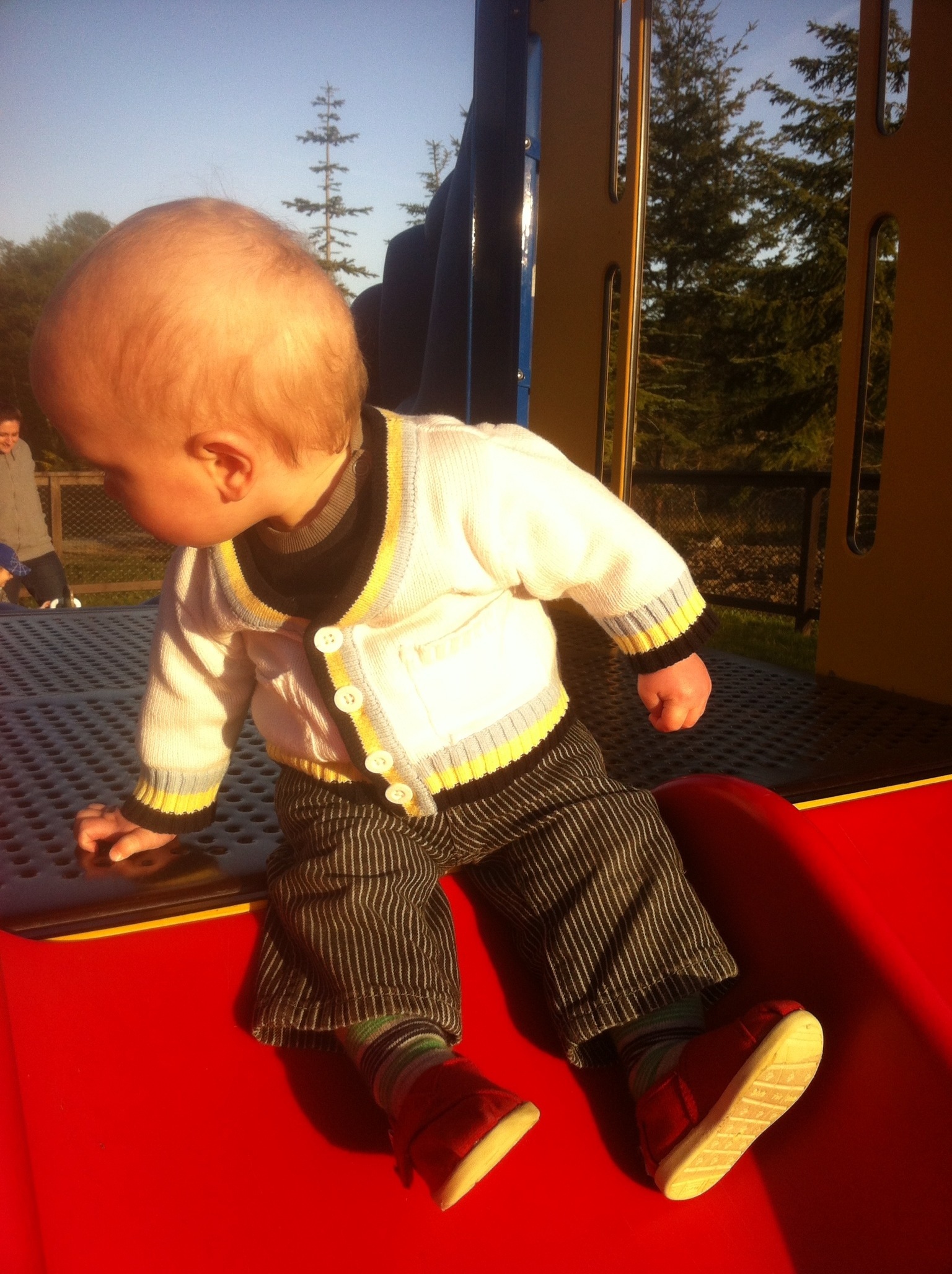
Toilet Learning the Montessori way…was not what we did…

I have been putting this post off. It seemed it would be one of those “do as I say, not as I do” scenarios. I have also received the full brunt of people’s opinions on the matter and I guess I’m dreading adding to that by posting this.

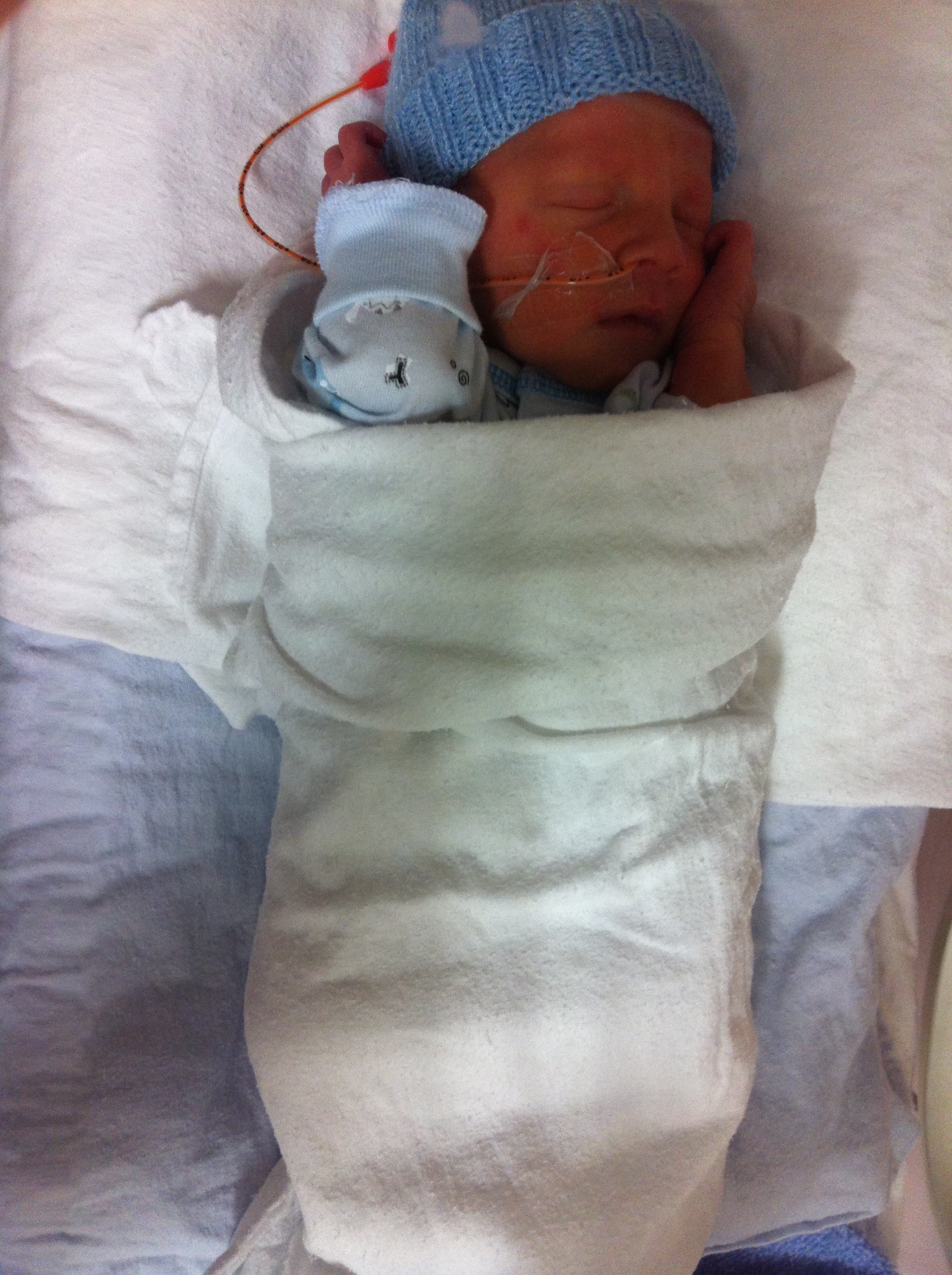
Perhaps I’m getting ahead of myself. I should start at the beginning, or to be precise, August of last year. That was when Quentin was out of the NICU, home from further hospital stays and things were finally settling in at home (4 months after he was born). With regards to toilet learning, Montessori homes/Nidos use cloth so as to give the child the opportunity to feel wetness, right from the beginning. Boy, did I ever have high hopes. My baby would never know the horribleness that is the disposable diaper. The waste, the chemicals. That was before he was born. After 4 months of being put in disposables by nurses, he was hooked. And to be truthful so were we. Please understand. We had beautiful, soft, natural, expensive cloth diapers given to us, and we did use them. Sort of. Every time we put him in them, this happened:

20130703-195611.jpg

And then this

20130703-195824.jpg

If they make cloth diapers for preemies, we certainly couldn’t find them around here. The beautiful soft cloth diapers were bulky, hot and hard to move around in. He got frustrated and so did we.

If at this point you’re rolling your eyes, stick with me. There is a light at the end of this tunnel.

Desperately wanting to bring Quentin’s diapering more in line with our Montessori values, we got a potty for him, and placed it in the bathroom when he was 8 months. This was only to have him see it. The Montessori pedagogy states that a child passes through the Sensitive Period for Toileting between 12 & 18 months old. We wanted to have him used to seeing the potty by then. We made no reference to it other than to casually say “Potty. That’s Quentin’s potty.” whenever we were in the bathroom with him for baths or while we brushed our teeth.

At 9 months we began Quentin sitting on the potty. Again it was not to do anything. Just to sit while we were in the bathroom. Following the child, we helped him off as soon as he did not want to be there, and we never left him there for an extended period of time. He would occasionally pee. It was more of a coincidence than anything.

At 10 months we set up his “Care of Self” area in the bathroom.
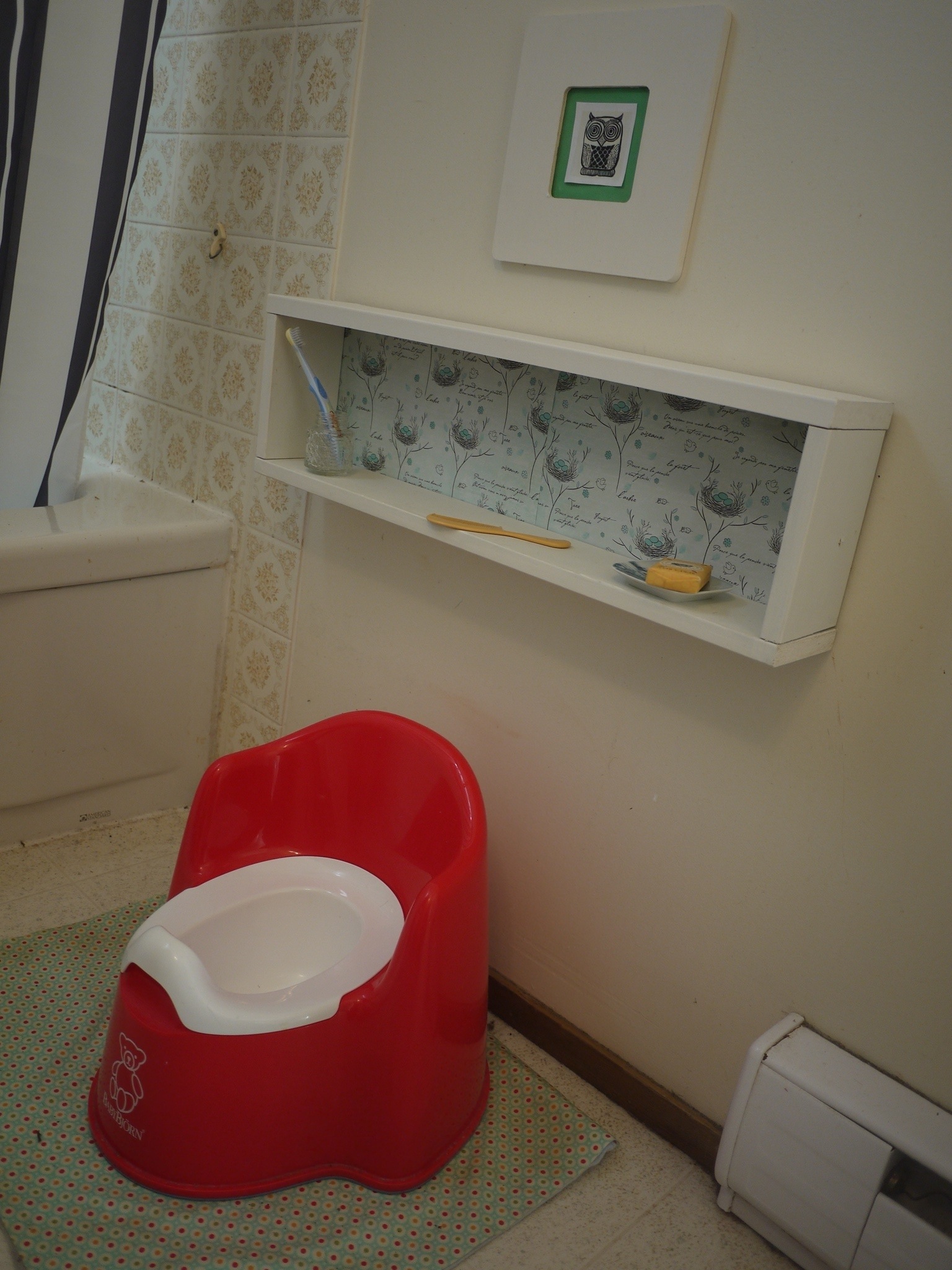
20130703-201132.jpg

I made the small shelf out of 1/2 metre of trim, some pretty scrapbook paper and a cereal box back. I ordered some pretty laminated fabric with a red that matched the potty (because yes, I’m that person) and made a little waterproof pad. We have the worlds smallest bathroom. We needed something that worked without getting in the way. The shelf holds Quentin’s tooth brush, comb and soap with dish nicely.

We started really observing Quentin’s toileting routine. We started taking him to sit on the potty after every meal, before leaving the house, coming back to the house and before bed. Each time, we asked him “would you like to pee?” and only kept him there until he wanted to go. If he protested, we would not take him then and try later.

He caught on immediately.

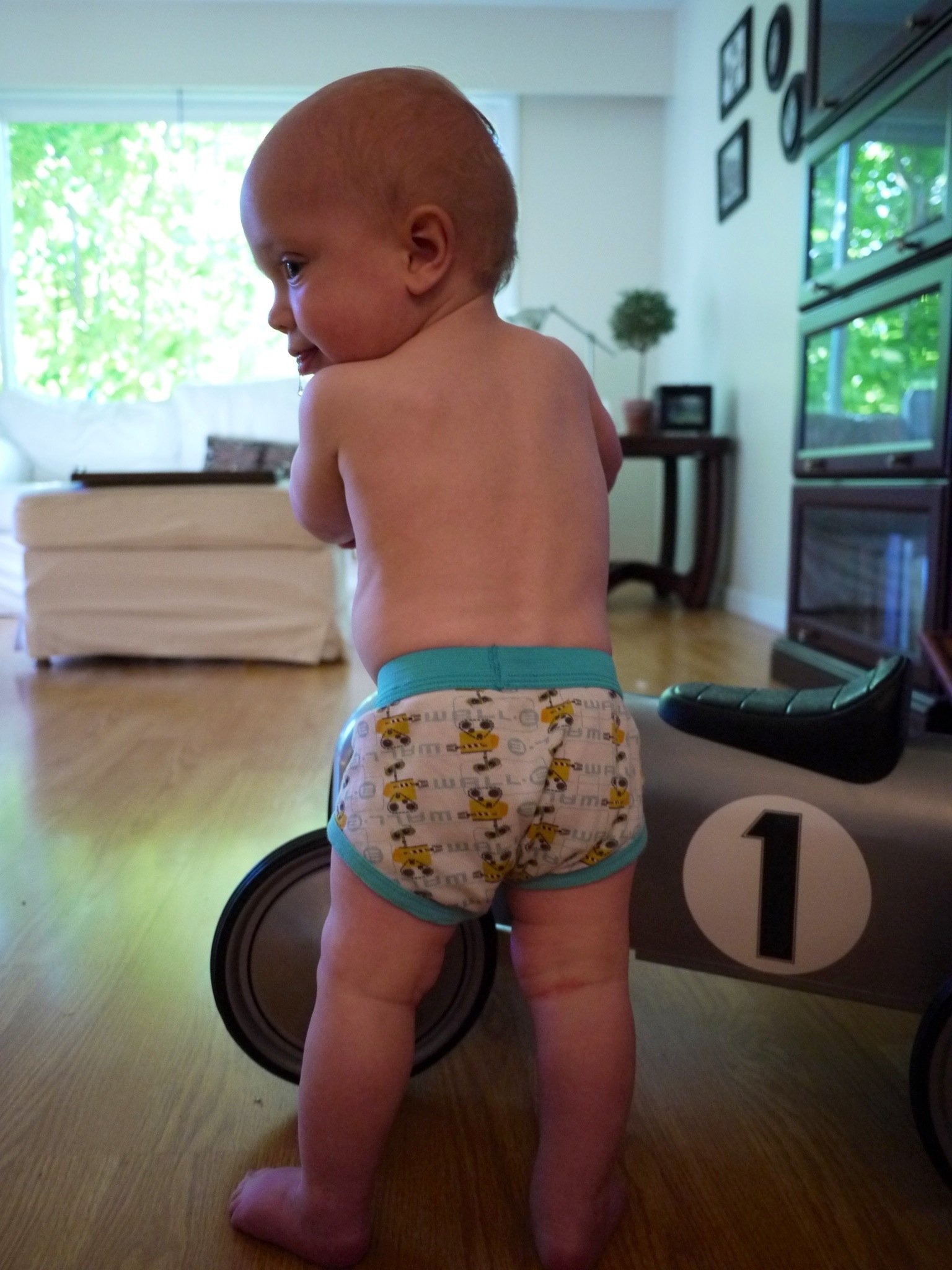
At 12 months we decided that we were far enough along to progress to underwear at home. We searched everywhere for something that would fit him. I had wanted to try “Under the Nile” since I had read good reviews from other Montessori families. I ordered their smallest size (12 month) but Quentin is in (still!) 3-6 month clothes. They were just too big and not going to work.

I scoured the web and came across these.

20130703-202430.jpg

I sent off Quentin’s measurements and she made them for me. They are perfect.

At 14 months (12 1/2 corrected age) Quentin has been successful in staying dry all day (including naps) for the past 3 days. We continue to take him, and he lets us know by yelling if we’ve left it too long. We’re trying to add the ASL sign for toilet to his repertoire of signs. He takes pride in “going,” saying “I did it” and flushing the toilet after I empty the potty. We (here comes my disclaimer) have never used rewards of any kind, nor punishments for Quentin. When he has an accident, we will ask “Did you pee in your underwear?” He will usually answer with his noise for yes. Then we walk him to the bathroom and help him get into clean clothes and wipe up any mess. We never shame or scold him. Just carry on with our day.

I’ve ordered this to complete his “Care of Self” area.

20130703-203905.jpg

I had no idea these existed until I saw it Pinned. It attaches to the bathtub. The perfect height.

I never expected the backlash on the topic. From complete strangers but also sadly from family.
“Really cracking the whip” is a mild example. “Oh! Well! You do Montessori (accompanied by an eye roll) is more hurtful. The list goes on.
We are not completely delusional. We know there will be accidents, and we have chosen to wait a little before trying “diaper less nights”. Montessori’s definition of Toilet Learning is that the child learns to recognize and control his/her elimination. Not just dry pants. There is not so much a start, although maybe at birth, and not so much an end as there is a progressing in aptitude.

It may not be the right way for everyone, and I know that it definitely is not a strictly Montessori way, but it is the way our family has done it. We just “Followed the Child”. Hey, maybe not so far off the Montessori path after all.
20130703-212804.jpg

Happy Canada Day

While there were many parties and community activities to mark the day, we spent the holiday together as a family quietly in our own small town.

20130701-194955.jpg

20130701-195033.jpg

A quiet breakfast of cereal, fruit and a glass of milk. Sometimes he’s very talkative at dinner, but at breakfast he’s always quiet. Contemplating his day perhaps.

20130701-200254.jpg

Yay! He’s not wearing a diaper! He actually made it the whole day in underwear including staying dry through two naps and out for a picnic lunch in the park overlooking the ocean.

When he got up from his afternoon nap, Anthony had this waiting for him.

20130701-200518.jpg

He loved it.

20130701-200628.jpg

Our big country is only 146 years old. A tiny blip compared to others. We are thankful to be together and live in such a peaceful, beautiful part of the world. Reading Children of the World has given Anthony new insight into just how lucky we are.

Some new store bought materials (gasp!) and a home made one

This was a week of new materials for the boys. Usually I try to make Quentin’s materials. Lets face it. They may not be relevant to him for very long and I love the fact that things can be easily made and easily recycled. However, there are so many beautiful store bought materials out there, and for us it’s the start of summer vacation. How could I resist?

20130628-202408.jpg

This arrived for both Quentin and Anthony. Quentin loves looking at the faces, and Anthony loves reading the poems with me and comparing how far away everything is. I guess when you live on an island, everything is far away. The photos are stunning, and the book is well laid out. It captivates both boys.

20130628-202629.jpg

This came for Quentin. At 14 months he definitely is in a sensitive period for opening things. I’ve seen similar boxes on Kylie’s site and on Rachel’s site. I immediately lusted after it and I couldn’t wait for Quentin to be ready to use it.

20130629-193024.jpg

This new placemat for our weaning table was made by my Mother. It was a wonderful surprise in our mailbox. Quentin feeds himself almost completely independently and that means we need more placemats. I love the fabric she chose.

20130629-193700.jpg

Lastly, these arrived for Anthony. Something that would take advantage of that summer sun. He tried a sheet and really enjoyed experimenting with different objects around the house. Oddly enough the tea ball (used for loose tea, not the toy) gave the nicest result.

Over the last few days there has been quite the discussion on the web of how “elitist” Montessori is. It makes me question my purchases. Should I feel guilty that I buy “expensive” materials for the boys? It would seem that society’s answer is yes. But I disagree. Instead of guilt I feel blessed. Blessed that I am able to carefully choose each material for my children, based on my observations of them. I don’t particularly feel the need to defend my love of beautiful books, interesting fabrics and natural materials. True, both my boys would do just fine with some dirt, sticks and rocks in the backyard. In fact we also spend many hours doing that. But I think a home can have a balance.

I’ve said it before that it’s all about the experiences. Whether store bought, home made or nature based, it’s the freedom we give our children to immerse themselves in the experience that’s important.

Everything I (and maybe you) need to know….Part 2: The first half of The First Plane

20130627-204701.jpg

“The greatness of the human personality begins at the hour of birth.” Maria Montessori “The Secret of Childhood”

So what exactly does that mean? Maria Montessori confirmed that children don’t learn the same way, at the same pace their whole life. The First Plane of Development (birth-6) is an amazing surge of growth. Not just physically but mentally as well. This is where children simply seem to “soak up” information about the world around them. Children begin to acquire language, develop cognitive and motor skills, begin to imitate the adults around them, and develop expectations of the world around them. Montessori described this period of learning as the Absorbent Mind.

From a Montessori perspective there are many experiences that a parent can offer, beginning in infancy that will help their child develop a life long love of learning (and I’m definitely not referring to flash cards here). It is also misunderstood that a parent needs to “buy all the expensive gear”.

20130627-210143.jpg

The Munari Moblie is the first in a series that can be offered to infants. We didn’t start with this one. We started with the Gobbi. I made it myself easily and cheaply. It was the first time I had made a material and I got hooked. Something beautiful to look at, a wall mirror and a soft blanket to lay on, is all that is needed to begin to build concentration: the foundation of learning.

I could go on forever about all the materials you could make/buy or all the activities you can do with your “under 3”, but that is not what this is about.

20130627-221306.jpg

20130627-221326.jpg

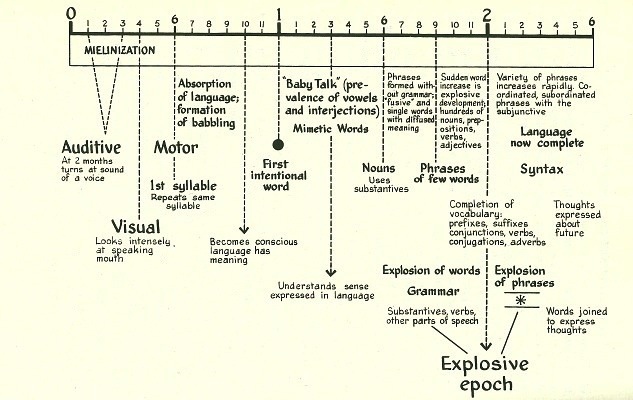
These are what this is about.

These charts taken from “The Absorbent Mind” outline what’s going on at every month between birth and 2 1/2. Knowing that every child’s body and brain go through these same milestones at roughly the same time can help a parent understand the often “strange” behaviour of “under 3’s”. A child has a fundamental need to exert maximum effort (throwing things). A child needs to imitate activities (gets in the way while making dinner).

So. What’s to be done with all this knowledge? Well, if you’re a Montessori family, you provide that prepared environment that allows the child to safely and constructively fulfill that need. This perhaps means looking at your space. Are the materials/toys beautiful, natural and realistic? Are they presented neatly (or spread all over the floor to trip over & curse). Is there time in the day for the child to move their body freely no matter what age they are? Do you slow your pace so the child has a chance to work along side you around the home experiencing all the sensorial world has to offer? Most importantly, do you respect your child as a human being. Capable of understanding real speech (not baby talk). Able to actually do real and meaningful work given the right size tools.

I guess the take away message is that a child starts learning at birth. You don’t need to worry about all “the materials”. If you’re going to worry about anything, worry about the experiences. Provide lots right from birth. Language, Sensorial, Mathematical, Cultural and Practical Life (Montessori language for life skills). These are the 5 that will build a lifetime love and curiosity for all the world has to offer.

Isn’t it funny that these 5 just happen to be the 5 areas of a Montessori classroom.

20130627-231742.jpg

Everything I (and maybe you) need to know about Montessori: Part 1

20130626-191249.jpg

When you hear the word Montessori what comes to mind? Most would say schools. Those that have little or no idea might say “That’s where the kids get to do whatever they want.” How many would correctly identify it as a pedagogy. A science or way of teaching. This pedagogy just happens to be directed at children, but not just “preschoolers”, and most certainly not just in a classroom.

20130626-192606.jpg

Maria Montessori used her medical background to study children of all ages, and walks of life. Over the years of studying how children learn, she set up “Children’s Houses”. A school unlike any other where children would be surrounded with natural, realistic beautiful materials. Montessori discovered that all people, right from birth are naturally curious about their environment.

Once the years of studying children and then designing the materials were complete, the rest flowed naturally. Invite a child (of any age) into a beautiful space (in Montessori language we call that a prepared environment). Give him/her an opportunity to freely move about that environment and choose freely from any prepared material they are intrigued by. Design the materials so that everything is accessible, easily manipulated, and has a built in control of error, so the child learns naturally from their own mistakes. Allow that child to work uninterrupted with that material for as long as they choose. Most importantly provide a Guide (in Montessori language we call her a Directress not a teacher), that will always speak quietly, respectfully and lovingly to the children. A guide that will assist the child in gaining new information, not telling the child what he should learn. A guide that will foster independence, without burdening the child with ego building praise. A guide that will demonstrate Grace and Courtesy (important words in the Montessori world) and Peace so that even the smallest child is able to show compassion. Over 100 years later, in over 100 countries, and 22,000 schools Montessori is changing the face of educating our children.

All this pedagogy or “way of teaching” is not limited to a school setting. That’s why many families all over the globe classify themselves (we are one of them) as Montessorians. We use the same fundamental principles described above in our own lives beginning at the birth of our children. Many would not agree with our practices that may include children self feeding, toilet learning and contributing to household chores at an earlier age than is readily accepted in most cultures. However I think all parents would agree that they love their children. Montessorians look at that love as a gift and a powerful one. Maria Montessori said “Within the child, lies the fate of the future.” I believe that was never more true than it is in todays world.

I will include this link for anyone wanting some ideas of materials. I would also encourage anyone to read Maria Montessori’s books. Especially the “Absorbent Mind”. You can find a link in a previous post. I will continue this series by going into greater detail on the different stages of a child’s development beginning from birth. I hope it will bring better clarity. Both to myself and others.

A Summer Bike Ride: Physical Activity & Sensory Work

Father’s Day fell on a beautifully sunny Sunday. We decided to seek adventure (on the small obtainable scale) and went for a bike ride and a picnic at the local lake.

20130617-190738.jpg

We took our time and stopped to observe our trail view.

20130617-191044.jpg

Lush green everywhere. What can I say, we live in a rainforest.

20130617-191321.jpg

The water was too cold for even the bravest swimmers.

20130617-203946.jpg

I love the fact that nature provides all the toys necessary for basic outdoor play. Sticks become shovels/scrapers/writing tools. Leaves and stones become everything from cars to castle windows and flags.

20130617-204247.jpg

20130617-204340.jpg

Quentin mostly just used the small stones to practice his pincer grasp which now includes the movement of his thumb and finger knuckles. He also showed his sensitivity for repetition and touch sensorial experiences by picking up handfuls of sand and letting it fall back to the beach through his fingers.

It was a good reminder that we can easily add a little physical activity to our day, but more importantly we can give the boys lasting memories of family adventures without spending a gob. We brought a blanket for the beach, $5 of healthy snack food and wore layers for the weather. We already owned the bikes but we could have just walked.

I am a big believer in Montessori Materials, and their obvious and significant impact on the Absorbent Mind. However I’m also a huge advocate of the fact that the entire world of a child is sensorial. A few handfuls of sand on a beach and the right stick also do wonders.

20130617-205929.jpg

Out in the Garden (Our Botany Lesson)

It was sunny and warm today. It could only mean one thing: Quentin’s first real experience in the garden.

20130602-220710.jpg

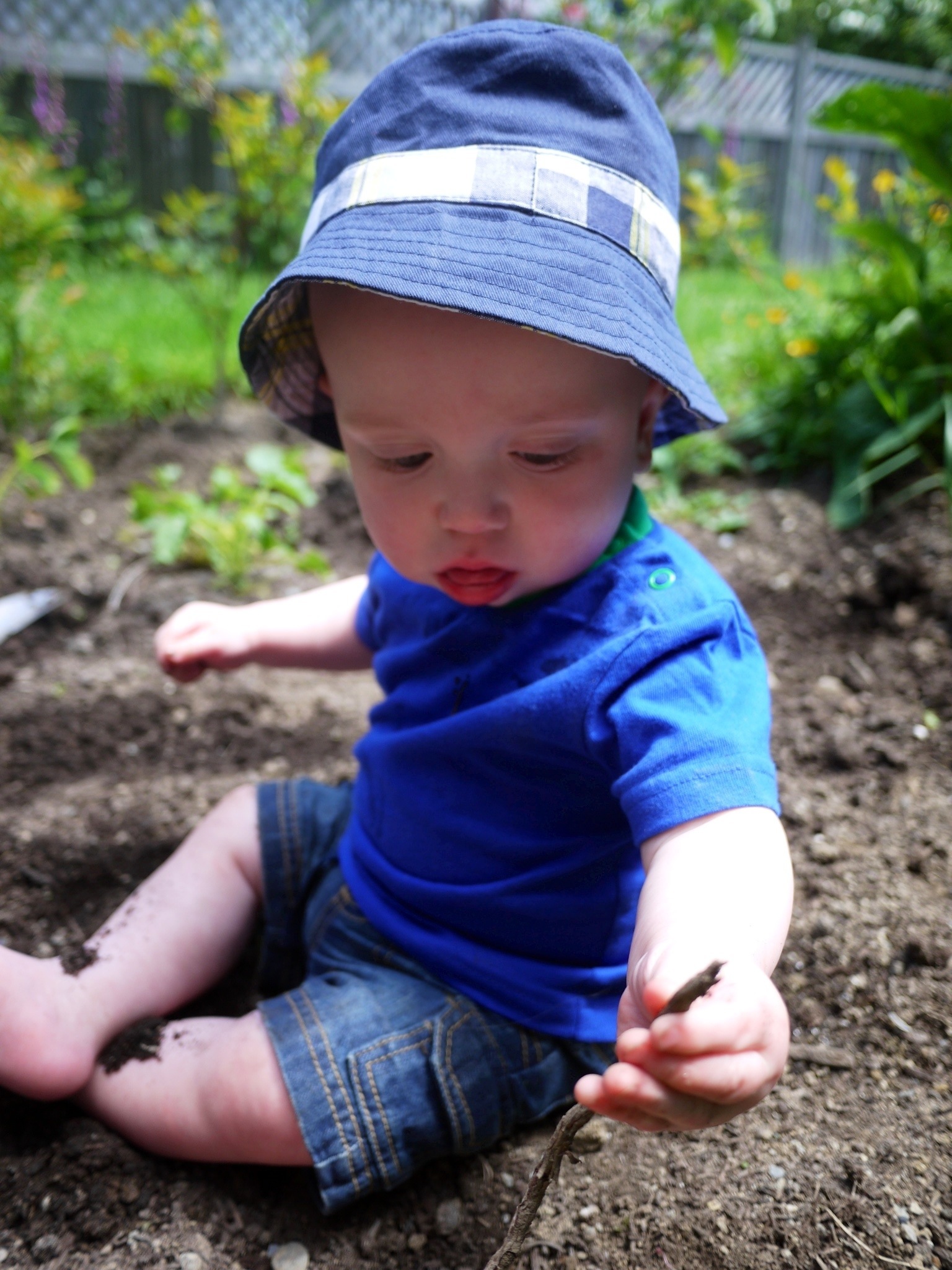
There was a lot of sensory exploring. Running his fingers through the dirt. Investigating small sticks and things.

20130602-221017.jpg

Surprisingly he only experimented with eating it once. A small clump. He decided it definitely wasn’t food. I love being able to share the joy of growing your own food (on a very small scale) with my boys. I also love that botany is what you make it, but that it can be easy to do with even very young children.

20130602-221728.jpg

Working in the Kitchen

20130517-104441.jpg

Practical Life Activities 12 months: washing dishes in his kitchen. Providing a child with the right child size materials allows them to do meaningful work independently. Even at a very young age. Kitchen & stool Ikea ($99.00)

20130517-104630.jpg

Independent Child

Does your child “play” by themselves?

20130511-111720.jpg

It’s something that many parents struggle with.
“Why are they so clingy?!”
“I’m so fed up! She won’t even play by herself for a few minutes so I can make dinner!”

Montessori spoke of this: “The environment itself will teach the child, if every error he makes is manifest to him, without the intervention of a parent or teacher, who should remain a quiet observer of all that happens.—Maria Montessori, The Secret of Childhood.

But how does this happen? Not over night, and certainly not if the child has become accustomed to the constant presence and attention of their parent during their every waking hour.
Gradually there must be a trust instilled in the child. Ideally this happens in infancy. Placing the unmoving baby safely on a comfortable movement mat with a mirror and mobile they can be left for a few minutes at a time in a safe room while we busy ourselves in the next room. The time expands as the child gets older until eventually they feel secure exploring in their own room or a child proofed room of the house. Sometimes up to 30 minutes or more.

If this has not been done in infancy, it’s still possible to get there. It just takes a little longer and a little more work. The path to getting there is the same. Start with letting the child be in a room independently working with something. If they are unable to be in the room alone, this stage may require you to sit somewhere near by for the first few times. It helps if you can set these times at the same time every day. Ideally when the house is calm. Perhaps it’s just after lunch. You can talk to the child about what you’re going to do before hand but keep it light and straightforward. For example: “I would like you to play with your toys while I finish cleaning the table.” Or: “I’m going to sit on the couch and watch you use your cars”. It will go more smoothly the more consistent you are. Three times is usually the magic number but it can take longer for your child to gain enough confidence in one stage before moving to a longer time. Sometimes it’s helpful to have a timer so the child knows that when their “alone time” is up. An hourglass works beautifully in this case as well.

No matter the resistance your child puts up, if you gently stand your ground they will eventually come to trust that you will not leave them and that they are a capable person able to do things for them self. And isn’t that what we want for them (and ourselves) anyway?

20130511-192213.jpg

Working independently: the 5 minute mark

20130511-192347.jpg

The 10 minute mark

20130511-192458.jpg

15 minutes

Following the Child

“The things he sees are not just remembered; they form a part of his soul.” – Maria Montessori.

Of all the Montessori quotes it’s this one that strikes at my core. It guides me through my days and unfortunately occasionally keeps me up at night.

20130508-204735.jpg

What has he seen today?

20130508-205146.jpg

Did he see beauty (not the superficial Hollywood kind)? Did he see patience and kindness?

Allowing the child to move at their own pace is often difficult if not extremely frustrating. This is made worse for us when we are in a rush. I tend to just want to do the thing he’s taking so long to do. It’s these times that this quote rattles around in my brain and I have to take a step back.
Other times it makes me stop and think carefully about our day. Did I rush him? Did I make time for him to watch the little family of sparrows that have made a nest in our maple tree? He loves them so much.

There have been many books written (most of Montessori’s own works) that touch on the act of “Following the Child”. Much of this is done by first observing (thats for another post) the child. I would encourage anyone who is interested to find a copy of “The Absorbent Mind” for more information on the subject, or speak with a Montessori teacher.

Today was a great day. Beautifully warm and sunny. Quentin completed a new work independently for the first time, worked on puzzles and woke up dry from his afternoon nap. We also stopped to watch the sparrows.

There is another Montessori quote that keeps me up at night:

20130508-213542.jpg

“It is the child who makes the man, and no man exists who was not made by the child he once was.”